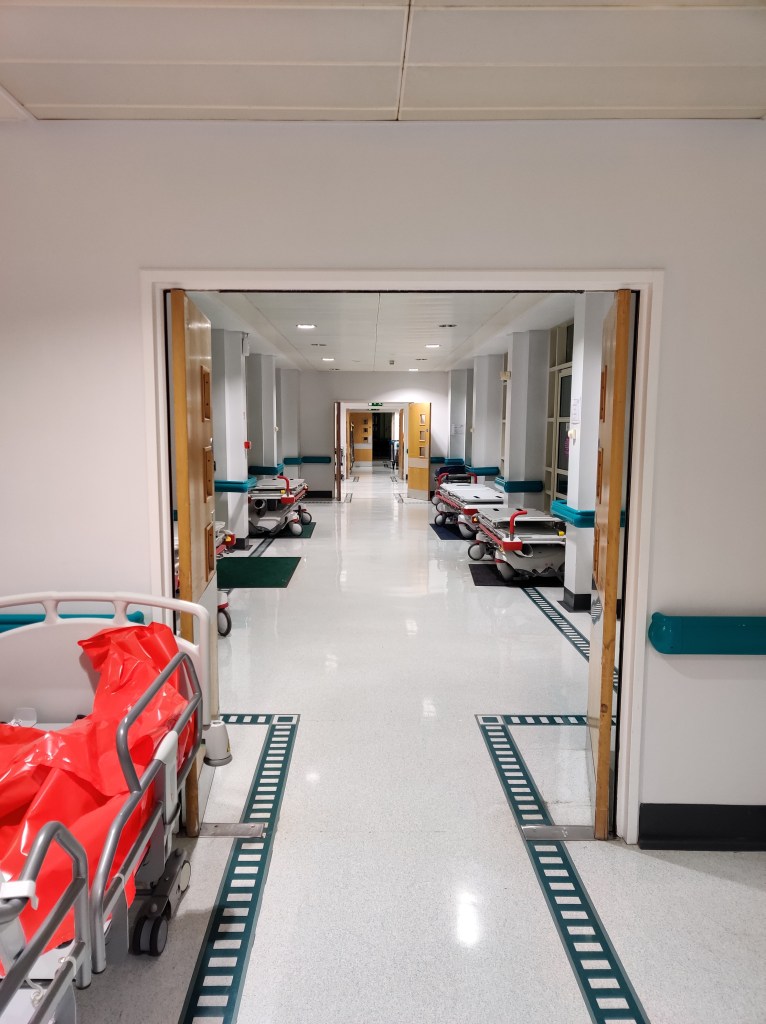
It was the middle of the night on my final weekend of General Surgical night on calls (see my post on surgical on call for more info). So far, it had been busy with several new admissions in quick succession. However, there finally came a point where both the hospital and I breathed a welcome sigh of relief as the influx of patients subsided, enabling me to transfer a patient to the CT (computed tomography) scanning unit. This was not a particularly acute situation – she had been unwell with a history of unopened bowels for 7 days or so, yet she was stable and relatively comfortable. As we wheeled her down the corridors, negotiating the ubiquitous yet universally loathed bumps in the flooring, there was some small talk between her, the porter, and I. But it was when we reached the CT scan department and patiently awaited our slot that an unexpectedly enlightening conversation began.
It all started with the patient’s experience of her current family practitioner, who she described as “reactive” as opposed to “proactive”.
“He just never seems to be proactive about maintaining my health and only reacts to what’s already there.”
I was puzzled. What could she mean by this? Was her doctor not predicting her health? Which begs the question, how miraculous does she perceive the healing capabilities of modern medicine to be? After all, as medics will unanimously testify, it is nigh impossible to diagnose ailments correctly 100% of the time, let alone predict the course of someone’s health.
“This is simply a gross misinterpretation of healthcare provision” I thought, indignantly.
She went on to expand.
“For example, he will see my blood test is abnormal, but he will only offer me a tablet instead of helping me stave off further problems associated with that first problem.”
Ok, fair enough. I still thought this was a bit of an overestimation of her clinician’s abilities, but I went away content with the presumption that she was probably just a bit frustrated with the system.
I continued with the remainder of my night shift without another thought of this encounter.
However, it wasn’t until a few weekends ago, during my Orthopaedic night shifts, that I came to recount this conversation and realised the wisdom which it had imparted. It had been a particularly busy night, with complex procedural challenges of which I had no prior experience. I had to make quick judgements under pressure and be in several places at once, yet suffered heavy criticism at the hands of the consultant in the morning, who decided to chastise me at maximal volume in the middle of the ward. Stomaching the humiliation with a firm gut, I proceeded to complete the ward round with neutral professionalism and returned home, brim-full of conflicted contemplations about whether I had been wrong, or the consultant had been unduly heavy handed.
As it transpired, personal reflection was the best antidote. It revealed a renewed determination beneath my wounded pride and severely knocked confidence. But it also precipitated the distant memories of the conversation I had had with the patient, whom I had helped transfer to the CT scanner. How could I have prevented the irate criticism to which I was subjected? Moreover, what exactly could I have pre-emptively done to preclude the embarrassment I suffered in the morning?
So that was it. It all made sense. Proactivity vs reactivity. Up until now, I had reacted to problems, situations, scenarios. I would manage things to a suitable point and then await the sound of my bleep to let me know if anything needed my further attention. It is worth bearing in mind that this is a fairly normal way of conducting business during an on call shift, whether it be at night-time or during the day. But it was all reactionary and reliant on an assumed temporal urgency, of which I had no control nor accurate scale. That is, I never knew how long the problem had been a problem before I was alerted to it. This would inevitably result in the last minute identification of problems, bursting open the floodgates to new issues that I would suddenly be expected to manage 100% perfectly under pressure with no additional support. Sounds pretty inconceivable, right?
So, with this in mind, I decided to shift gears and unbox some fresh components for a cognitive overhaul. What if I pre-emptively – no – proactively practised best practice in order to achieve best practice by the morning? What if I reviewed problems before I was bleeped about them?
There’s no real set way of undertaking a night shift on Orthopaedics. So much variability exists between different trusts, for example a major trauma centre with a large patient population will have a much busier workload with more unwell patients than a district general hospital with a smaller population. The distinct difference between my experience in General Surgery and Orthopaedics, however, is that the expectation in Orthopaedics is military sharp. No matter how busy it is, you will always be criticised for the 1% you missed. It can really be demoralising; I’ve definitely felt it. Yet, in an acute effort to reduce the chance of this, I’ve now started to conduct a night ward round for all the preoperative patients to proactively ensure they are all ready for the operating theatre the following day. This involves making note of all the patients who have been listed for theatre and then physically seeing them in person to make sure they have their IV (intravenous) fluids prescribed ready for when they’ll be nil by mouth, are suitably pain free with regular and PRN (pro re nata – in medicopharmacological terminology is means “as required”) analgesia prescribed, and have had an ECG (echocardiogram – a 3-12 lead heart trace) and chest X-ray done for the anaesthetist. This includes patients seen during the day, as, frustratingly, there’s a tendency to suffer criticism as the night SHO (senior house officer) in the morning trauma meeting for the shortfall of the day team. It’s also nice to just give a once over to the Orthopaedic patients on each of the wards so that the nursing staff know that I’m around and can ask me any questions they may have about the patients before any problems arise and I am bleeped at 0500 to review 6 unwell patients at once. All of this is documented in concise entries just to record that everybody is aware of the plan and that I have seen the patient overnight. It’s genuinely made a world of difference and provides overwhelming peace of mind.
Ultimately, all of this extra work just serves to optimise patient care overnight and smooth out the following day’s operating list, which is genuinely like Christmas come early for the Orthopaedic and Anaesthetic consultants in the morning trauma meeting. It doesn’t, however, exempt you from the industrial wood fired oven roasting you get as a measly SHO desperately clawing onto some remnant of dignity as your ego is ruthlessly shredded to fragments in front of a live audience. But hey, there’s nothing better than tradition… is there?
 Vasudev Zaver
One thought on “How to Master the Orthopaedic Nightshift”