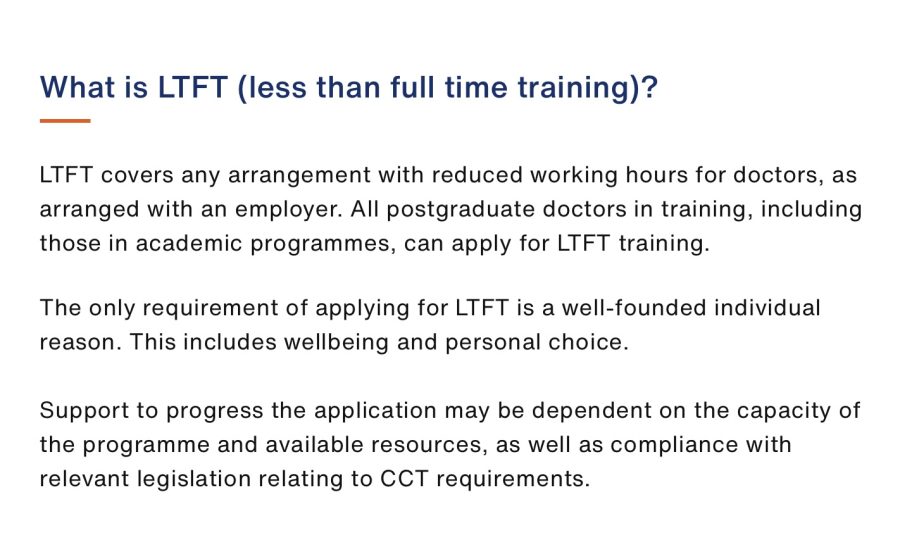
I recently opted to reduce my working time from 100% full time to 80% less than full time and haven’t looked back. It’s genuinely one of the best things I’ve done to safeguard the durability of my training.
Less than full time (LTFT) working in the NHS has been around for a while but it has recently been improved by becoming even more inclusive. As it stands, you now no longer need a reason to work LTFT and instead can jump through the relevant hoops and adjust your hours ahead of your next rotation(s). Usually you need enough lead time to ensure the work schedules can be adjusted, however, I was quite lucky and found it to be a relatively smooth process.
First of all, I had a read of the deanery resources through the NHS England website (previously Health Education England). The exact process involved the following steps:
- Seeking approval from the training programme director.
- Completing the deanery LTFT request form, outlining whether you wish to opt for 60% or 80% LTFT – this may vary between regions, but for my region it’s all managed by a Lead Employer, which can make these sorts of processes a lot easier.
- Liaising with the next hospital to establish the logistics.
I personally opted for 80% LTFT for routine activity, and 100% full time for on call duties. This is because the on calls take place relatively sporadically so I felt like I could still manage this, along with the fact that it would incur less of a pay reduction.
My experience so far has been great. During my current placement, I take every Wednesday off which affords me a guaranteed, protected day to pursue any non-clinical activity I wish. I personally chose to go LTFT because I wanted to focus on some non-NHS related activities, including entrepreneurial ideas that I had. It’s really refreshed my perspective on my clinical work and provided me with a renewed sense of agency, which is truly a gift in the current climate of burnout. Towards the end of ST4, I had felt really fatigued and wasn’t enjoying my work as much, which is a tough way to feel given the relentlessness of the job. There’s not much room for give so I felt as though I either compromised my own health and wellbeing to keep up the pace, or I take my foot off the gas somewhat to make it all more manageable. I deduced the latter would be more beneficial and so went through the process and genuinely haven’t looked back.
So, I’ll go through the pros and cons to try and create a balanced picture of my experience so far:
| Pros | Cons |
| Provides a sense of agency. This is time for you! | Can feel like a bit of a cram to take all annual leave days in addition to LTFT days. |
| Competency based so technically you can still progress at the same rate if you meet the training requirements. | Can cause delay to progression if not all competencies met in timescale of each placement. |
| It’s protected non-clinical time where you’re not obligated to undertake any clinical activities. | Requires a bit of logistical planning and review of trainer job plans to figure out the best time to take LTFT day for each placement. |
| Opportunity to step back from NHS work and take a breather. | Can sometimes feels challenging to have conversations with trainers about LTFT day and your absence from clinical activities e.g. can’t do a ward round etc. |
| Time to explore other avenues e.g. non-NHS ideas, industry, extra-curricular activities. | |
| Extra time to rest and recuperate! I’m no longer as fit and resilient as I was when I was 25 so I find it much harder to bounce back from back to back shifts, including night shifts and on-calls. | |
| Extra time every week to spend with family, partner, children, friends / pursue hobbies / do absolutely nothing. |
Top tips!
- If you feel like going LTFT or have considered it even for a moment then go for it! Be mindful that it can take a while to process so the sooner you submit your application, the more you can plan ahead.
- Decide if you want to take 80% LTFT for both routine activities and on calls or you want to keep on calls at 100% full time. Your pay will be affected so it’s worth giving this some thought.
- Email your clinical supervisor for your next placement to obtain their job plan ahead of time, ideally at least 8-12 weeks beforehand. This is because your work schedule with your chosen LTFT day will need to be finalised 6-8 weeks before you start the placement so time is of the essence. It also makes you look proactive and can convey a good impression.
- Figure out when your clinical supervisor has programmed clinical activity and which days or sessions they have away from NHS activity. I’d recommend matching your LTFT day to this if you want to ensure minimal disruption to your clinical contact time. The good thing is that your boss will typically have at least 2 sessions off a week for admin time or non-NHS work. If you don’t take this time then often these gaps are filled with a flexible session which essentially translates into fair game for reallocation to fill rota gaps or help with the on call.
- Be diligent with your clinical requirements to reduce the risk of delays to progression as much as possible. As mentioned in the table above, if you hit your competencies then technically (according to current guidance) you should be allowed to progress at the same rate as 100% full time work.
So, as a final word, I just want to say that this is all subjective and can very much depend on your life circumstances. However, I genuinely stand by the fact that this was one of my best decisions in training. It’s potentially staved off an inevitable burnout and helped me carry on with my training. It can take a bit of figuring out to begin with, but once everything is in place then it rolls pretty smoothly.
I feel very lucky at how far LTFT has come and want to issue a sincere thanks to those who came before and paved the way for people like me to adopt this adjusted working pattern. Let’s keep up this energy and continue improving training for all 🙌🏾.
If you found this article useful, share it with your friends and colleagues to help them too!
 Vasudev Zaver